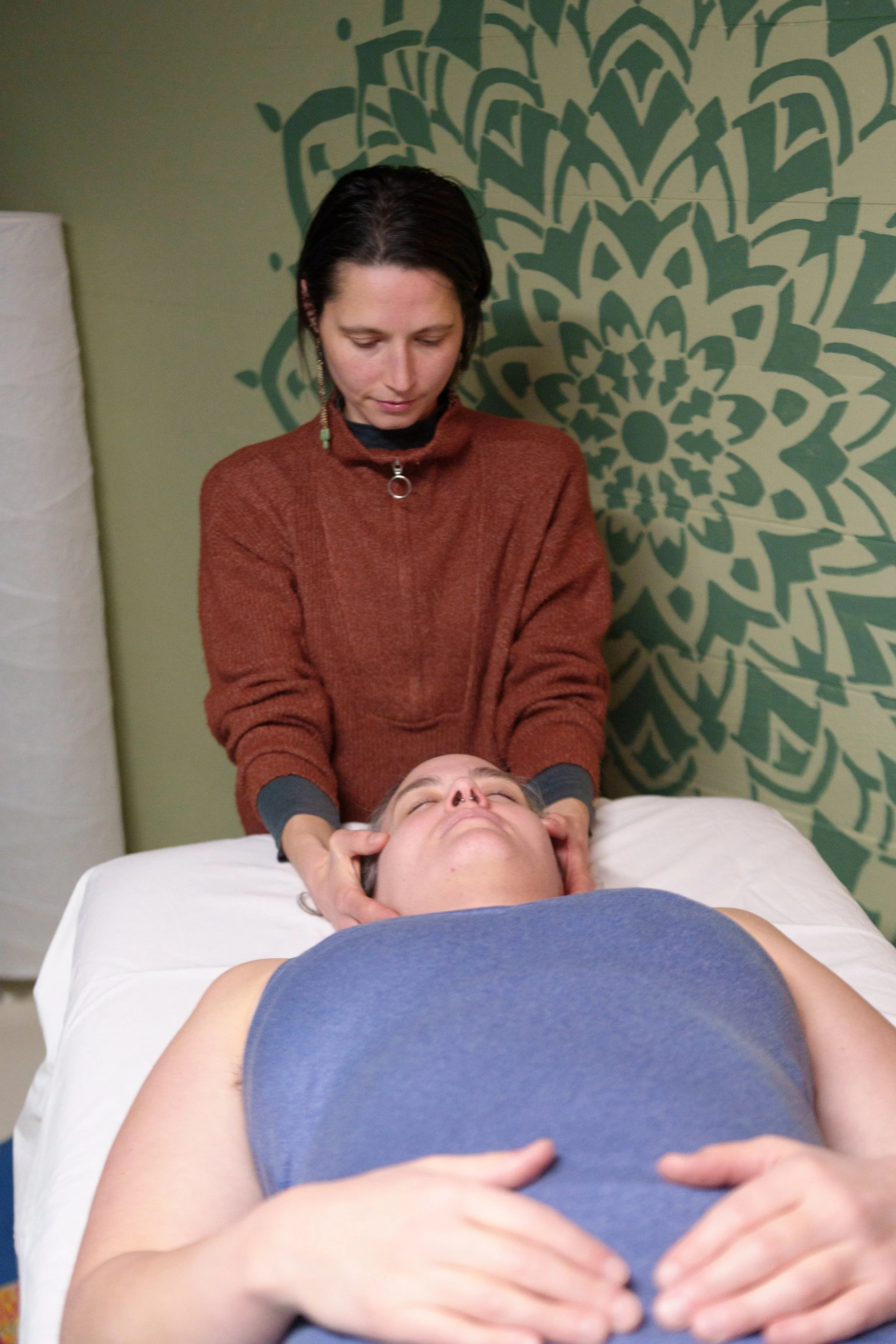
Spoiler: less like massage, more like a deep nap.
What the heck is CranioSacral Therapy, anyway?
When I tell people what I do for work, one of two things usually happens:
1.) Their eyes light up, they stand a full six inches taller and their feet nearly leave the ground as they say “OMG, I LOVE CranioSacral Therapy!!!”
or
2.) Their face twists into a quizzical, confused contortion and they say “CranioSacral Therapy? What’s that?”
It’s a big name for a simple bodywork practice. CranioSacral Therapy is done on a table similar to massage, but there is no digging into tissue or adjusting bones. Instead, I rest my hands gently on an area where I feel restrictions and wait to see how your body responds. This very light touch helps your body release tension on its own, without forceful adjustments.
Some people don’t even feel my hands, but might experience sensations like tingling or stomach gurgling. It’s common for clients to feel a deep sense of relaxation and some of them even fall asleep (that’s totally okay!) This relaxed state helps your nervous system “power down” so it can rebalance and restore itself.
What to Expect for Your First CranioSacral Therapy Session
What to wear: Unlike massage, you remain fully clothed for a CranioSacral Therapy session. Wear loose, comfortable clothing you can move around in. Socks are fine, but not required. (Seriously, there’s no need to apologize for your feet. Feet are just feet.) Most people wear sweats, yoga pants, or even their pajamas. It’s all good as long as you’re comfortable.
Things like belts and watches can get in the way, so either leave those at home or remove them before the session.
When you get here: For new clients, I ask them to book 90 minutes. The first session is a bit longer because we’re new to each other and it takes some time to settle in. Before you get on the table, we’ll spend some time going over what brought you in, what you’re struggling with, and what you hope to get out of our time together.
You’re in charge. You can ask questions, move around, change positions, or take a break at any time. There’s no expectation to be still or quiet. Sometimes, shifting things in the body can make room for difficult emotions to come to the surface. It’s okay to talk about it and crying is totally allowed.
What Does CranioSacral Therapy Feel Like?
CranioSacral Therapy vs. massage
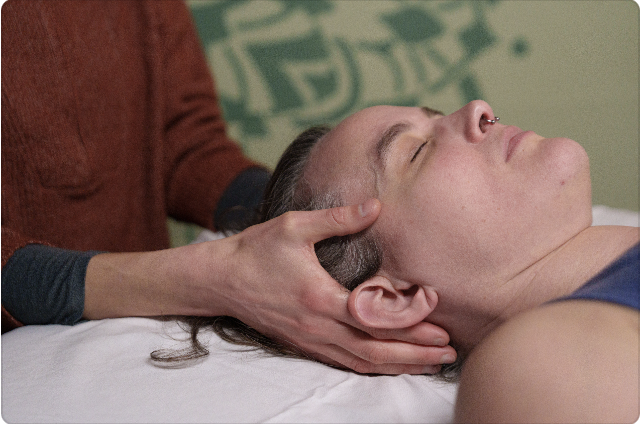
If you’ve had massage before, you’ve felt the deep pressure of someone rubbing or digging into tissue. CranioSacral Therapy is different in that the pressure I use is roughly the weight of a dime.
I might rest my hands at the base of your skull to feel for your CranioSacral Rhythm (more on that later), or I might hang out at a shoulder, hip, knee, or foot. I go where I find restrictions, which might not always be at your head or sacrum. It might not even be where the pain is. Often, restrictions in one area result in pain somewhere else, so I look for where things are not moving well and start there.
We go deeper into this in our blog post, Your Body Isn’t Failing You.
In CranioSacral Therapy, I might move around to different places in your body, but the holds are long and still, rather than kneading. I find a restriction. Hold. And wait for your nervous system to respond. Over the course of an hour, I may only touch two or three places on your body. By tapping into your nervous system, I can follow and listen to what your body wants to do. If it wants to go a particular direction, there’s probably a reason.
🤓 Nerd Alert! Skip ahead if you just want to feel better. No pop quiz, I promise.
In CST training, we learn to feel what’s called the CranioSacral Rhythm, a subtle, slow rhythm many practitioners describe as connected to the movement of cerebrospinal fluid. It’s easiest to feel at the base of the skull, and it helps guide where I work.
What do people commonly notice in a CranioSacral Therapy Session?
The most common thing people say after a CranioSacral Therapy session is that they feel deeply relaxed. Some say the most noticeable difference is a reeeeeaalllly good night of sleep, even if they haven’t had any previous trouble sleeping. Sometimes, people even fall asleep during a session (and that’s totally fine!)
It’s possible that nothing dramatic happens and that is also fine. Some changes show up later. Remember, your nervous system is in charge and you might not consciously see shifts until after they’ve happened.
Others notice sensations like tingling, pulsing, or a sense of things softening and unwinding. Memories or emotions might come up. This is all completely normal. When we move things in the body, we make space for emotions to come to the surface. There is no “wrong” way to experience CranioSacral Therapy.
When emotions bubble up to the surface, SomatoEmotional Release (SER) can be helpful. SER uses dialogue to engage with emotions and sensations in the body so they can move through you instead of staying stuck, sometimes resulting in a release of physical tension. I don’t analyze or diagnose anything. If something heavy comes up, I may suggest additional support from a counselor.
Is CranioSacral Therapy Right for me?
Many people find CranioSacral Therapy helpful support for a variety of issues. An acupuncturist friend of mine calls it “watering the roots of the tree.” People seek out CranioSacral Therapy for conditions such as:
TMJ
Stress and anxiety
Back and hip pain
Sleep issues
Sinus congestion
Emotional release
. . . and many others
We don’t claim to cure anything, but rather offer support for your body to rebalance itself, making CST a useful tool on its own or as a supplement with other practices such as:
Chiropractic
Massage
Acupuncture
Mental health counseling
Myofascial release (MFR)
Breathwork
Physical therapy
Our Total Body Reset Package offers one session of CranioSacral Therapy and one session of Posture and Pain Relief massage, helping you tune into your nervous system while also getting deep structural work for specific pain issues.
In the end, the best way to know what something feels like is to experience it.
or
if you have a question I didn’t answer here.