Your Body Isn’t Failing You.
It’s actually quite brilliant. And you can work with it instead of against it.
What if the posture and pain you feel shame about is the very thing keeping you going?
You've done all the "right" things. Stretching every day, hot yoga, the foam roller stashed in the corner of your living room. . . but the pain keeps coming back. And you're left wondering: “Why does my body hurt for no reason? Is my body just broken? Is bad posture my fault?”
This isn't another post telling you what to do. Just a new way to see your body. You don't need another stretch to add to your to-do list and then feel guilty about skipping. In fact, un-shaming the stretching myths is exactly what we’re here to do. (If your pain is persistent or getting worse, check with your doctor.)
It’s common for CranioSacral Therapy and massage clients to walk through our door with shoulders rounded, head drooped, and apologizing for their posture. “I try to do yoga every day, but I missed it twice this week,” they say as though our office is a confessional. Somewhere along the way, they picked up a belief that rounded shoulders and tight hamstrings are a moral failing worthy of torture in the form of daily stretching.
Slouching gets a bad rep because it’s associated with laziness or weakness. This “perfect posture” myth has a lot to do with socially acceptable aesthetics rather than what your body is actually doing- keeping you safe.
Is “bad posture” my fault?
You are not lazy. Your body is doing exactly what it’s designed to do, which is to protect you.
Posture is dynamic and adaptive, not a single fixed position. As far as we know, there is no such thing as “perfect” posture. Posture is simply how your body organizes itself from moment to moment, adopting the safest and most efficient alignment. “Stand up straight” is well-meaning advice, but if fixing posture was that simple, no one would have postural issues. We’d all simply stand up straight and be done with neck and back pain, easy peasy.
For most of us, consciously sitting up straight feels good in the moment. But if it’s “correct,” why doesn't the body stay there? Your body is smart and knows that the temporary relief of sitting up straight isn't as important as what it's trying to protect by rounding forward
If you want to get real nerdy about biomechanics, I love Katy Bowman’s take in her blog post Alignment is not Posture.
If we judged “correctness” based on what something looks like, then logically Eric should have a lot more pain in his body than he does. Eric was born with cerebral palsy and walks with a limp. Most biomechanists would look at him and see a body that is “out of alignment.” Because Eric practices resistance stretching, which balances the tension in his body, he lives with very little pain and is in fact, quite athletic.
On the other hand, as a former dancer, people have often commended my posture without realizing how much pain I was in. Years of bracing my shoulders, pulling in my belly, and an injury that took over 20 years to unravel have all contributed to pain and limitations in my body that “looks” correct.
Why do I carry all this tension in my body?
(It’s not proof you did something wrong.)
If you wake up with tension or body aches for no reason and hobble out of bed grumbling “why does my back hurt when I didn’t even do anything?,” you’re not alone. (Hey, it’s a high-ranking keyword phrase for a reason!)
The world we live in forces us into postures we didn’t evolve for, creating an imbalance in tension. By the time that tension registers as pain, some muscle has been working overtime in a job it wasn’t designed to do. That’s why pain isn’t always where the problem is, and digging into the neck and shoulders because they hurt doesn’t always get lasting results.
You need tension in your body. Without it, we’d all be a pile of bones and tissue.Tension keeps us upright. It keeps our bones, ligaments, and tendons working together so we don’t collapse into Jell-O.
For our purposes, I’ll talk about three kinds of tension. Don’t worry, you only need to remember one for now:
Structural tension, like a suspension bridge.
Mechanical tension, which puts muscles under load to build strength.
Bracing tension, like when someone sneaks up behind you and scares the bejeezus out of you.
When it comes to pain, we’re usually talking about bracing tension. This is the kind of tension that happens when we’re in fight-or-flight. The body can hold onto that bracing mechanism long after the danger is gone, like when your dog keeps barking even though the mailman is halfway down the street. (Our dog, Harlequin, says she knows nothing about this.)
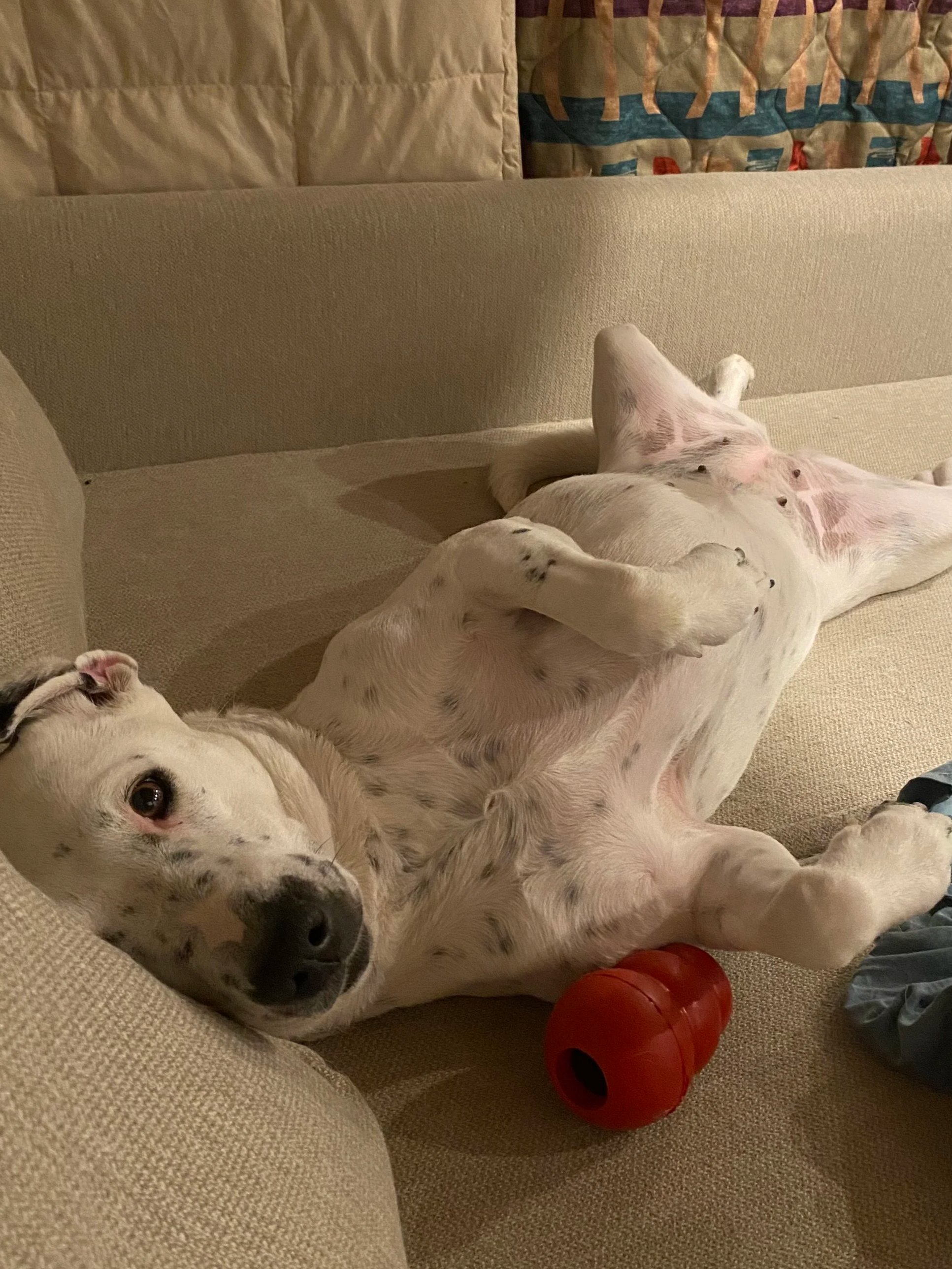
Who, me?Obviously, Harlequin never barks at anything she’s not supposed to. . . but IF she did, it would be because she’s protecting us. That’s when I would ask her to pay attention to me, sit, lay down, and have a snack. I redirect her.
Her barking isn’t a defect, it’s a feature. And pain works much the same way. Your body is pointing at something. In this case, the "redirect" is to find the complementary muscles not tensioned correctly so that the muscles screaming at you can get a break.
As bodyworkers, we get excited when we find tension in your body. To be clear, we’re not excited that you’re in pain, we’re excited that we found where things are bound up so we can help with CranioSacral Therapy and massage. If you have a lot of pain but not a lot of tension, it might mean something more complex is going on and it's worth checking with your doctor.
The “I don’t stretch enough” Myth
The way we’ve been taught to stretch leaves us feeling loose but doesn’t balance the tension we need for stability. It might make sense that pain= tightness and tightness= needs stretching. But again, if stretching solved everything, you probably wouldn’t be on the internet searching “do I need to stretch every day?”
Having a yoga practice is great if you love it and feel good doing it. But it seems important to say that yoga culture represents an imbalanced number of people who are already hypermobile (meaning their joints that can bend beyond a normal range of motion), rather than the general population. This tends to promote the idea that flexibility is a virtue and that not being able to touch your toes is something that needs to be “fixed.”
Here’s a common pattern we see:
pain → stretching → protection → more tightness → more pain → more stretching → more protection → more tightness → WTF?
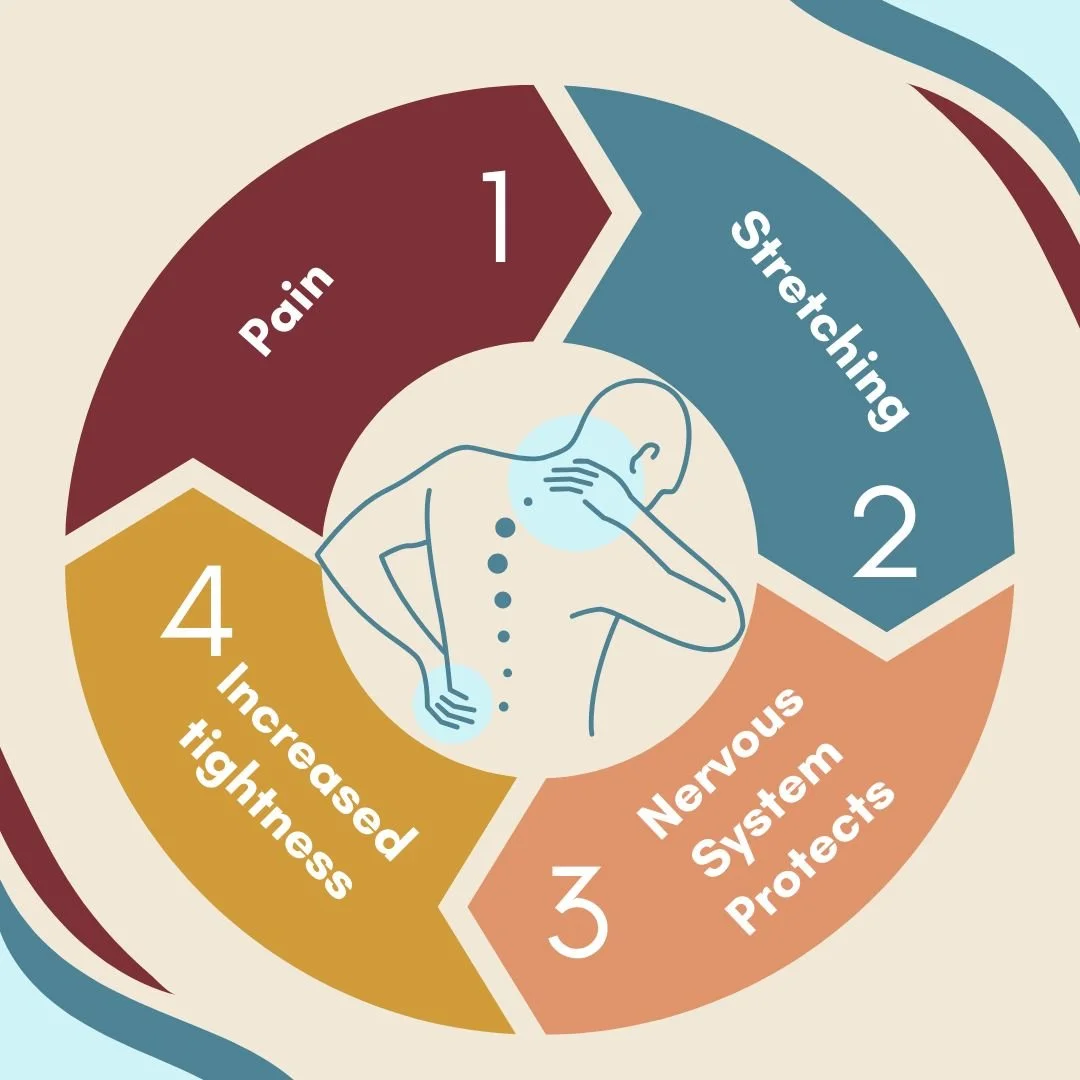
Look familiar?
If your hamstrings feel like steel cables even though you stretch, your body might be protecting something. Stretching can feel good in the moment but for some people, symptoms return or come back with a vengeance after a few hours. That’s when it’s time to look at a different approach, like resistance stretching (not the same as conventional stretching, we’ll get into that in another blog post!) or strengthening other muscles to support balanced, functional tension- like a suspension bridge.
How Bodywork Can Help
We are not meant to go through pain alone. If you’d like some support with body tension that won’t go away, that’s exactly what we help with. The Total Body Reset package offers inside-out care, including structural work with Posture and Pain Relief, and gentle nervous system support with CranioSacral Therapy.
Posture and Pain Relief is a unique style of massage done on the floor, fully clothed. Eric uses his feet, but not like Thai or Ashiatsu massage. Because Eric starts with the lower body first, his clients often notice their neck and shoulders loosen up without ever digging into those areas directly. This helps loosen gripping muscles to improve usable range of motion. Then, he uses resistance stretching, which strengthens muscles in their entire range of motion, not just pulling on things that feel tight.
CranioSacral Therapy (CST) is a gentle style of bodywork. With a light touch (about the weight of a dime), I feel through the subtle rhythms of your body and help the nervous system release restrictions on its own. Sometimes, emotions stored in the body can contribute to physical pain. CST can make space for difficult emotions so they can move through you instead of staying stuck. If someone is carrying something particularly deep, I might recommend additional support from a counselor.
You can book CST and massage individually or bundle them together with the Total Body Reset package, which includes one session of Posture and Pain Relief and one session of CranioSacral Therapy at 15% off.
Your body isn’t failing you. And neither are you.